

From the history of the Ois
From the history of the Ois
Our Ois – a journey back 300 years
Our Ois is now almost 300 years old, at least if you go by the dates written in various places on the vineyard.
300 years ago, in the middle of the 18th century, was a turbulent time in the area that today comprises the Palatinate. As is so often the case, conflicts between the great European ruling houses took place and left their mark.
At the end of the Thirty Years’ War in 1648, the rule over Alsace and Lorraine fell to the French royal family. Louis XIV, who was King of France from 1643 until his death in 1715, was always keen to extend his domain. The War of the Palatinate Succession provoked by Louis began in 1688 and lasted until 1697.
In 1688, Ludwig began to develop the town of Landau, which lay directly on the border of the Holy Roman Empire, into a fortress. The construction of the fortress officially lasted until 1691, but by no means ended after three years and continued well into the 18th century. The fortifications naturally evolved in line with the development of military technology.
But what does big politics have to do with the Ois?
 Well, the keystone above the entrance archway may provide a clue. It shows a lock with two barges. Below it is the inscription “CANAL”. Above it are two stylized lilies. To the left are the dates 1734 and on the right the monograms H and AM.
Let’s start with the locks and the CANAL. The construction of the Landau fortress, which was commissioned to Vauban, Louis XIV’s master fortress builder, naturally required wood and stone as building materials. Both were plentiful in the Palatinate Forest.
Wood, sandstone, gneiss from Albersweiler and lime from the Kalmit and Siebeldingen. In order to bring the building materials to Landau, a canal was built in the Queich river valley, the so-called Albersweiler Canal. It ran from Albersweiler to the gates of Landau and ended where the Westbahnhof railway station is located today.
To overcome the height difference of almost 12 meters, several locks had to be built along the route. An old plan shows that there were three locks and a lock keeper’s house in the Siebeldingen area of the canal.
As our vineyardis located somewhat to the north of the canal and the size of the buildings, including stables, an outbuilding and an enclosure, is relatively large, this suggests that the inhabitants, supposedly officials of the French state, were responsible for the administration of the canal.
References to the builders
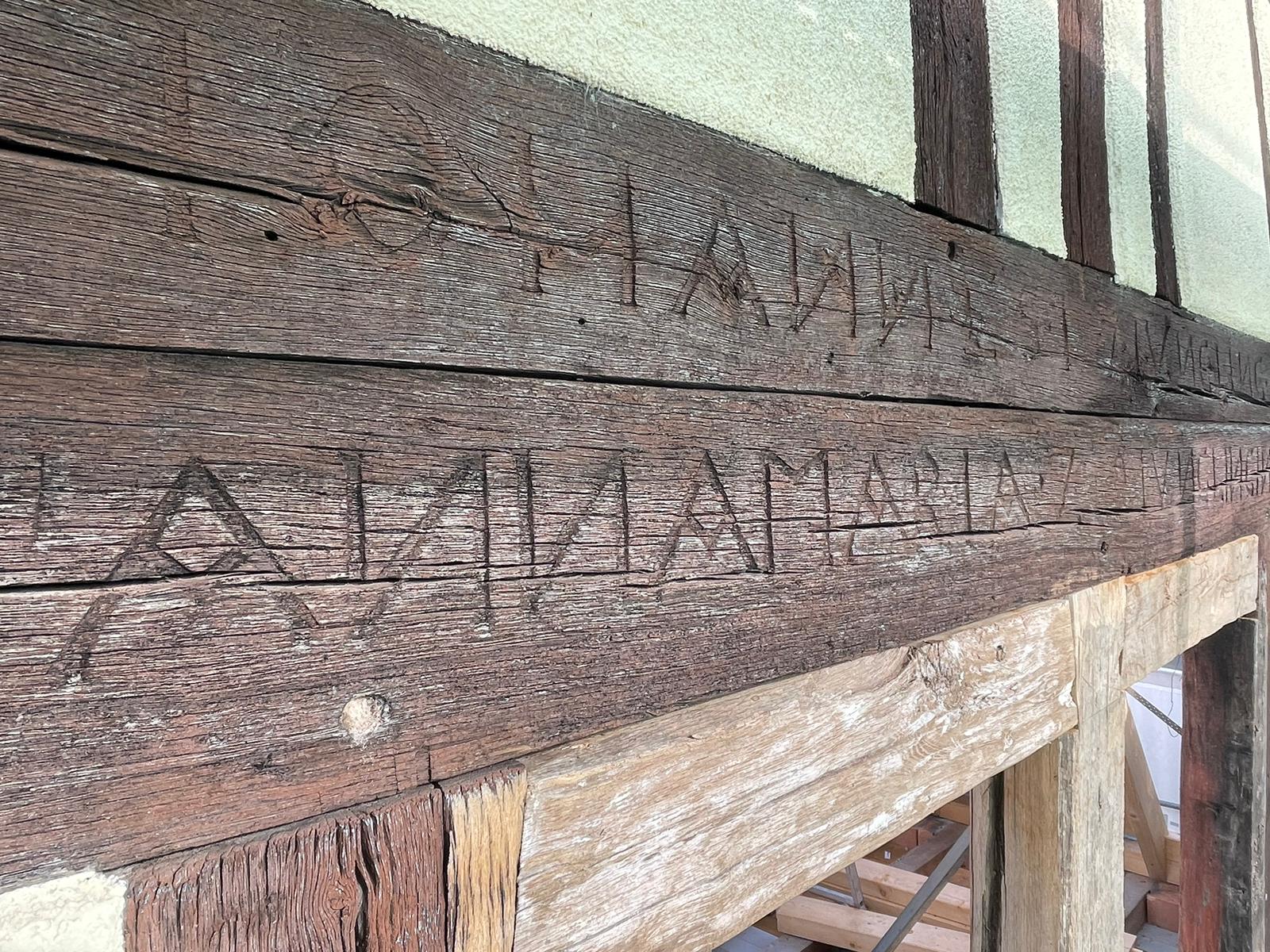
The two lilies above the stylized sluice give us a clue that the builders were Huguenots. On the main house, the names Hannes Jüngling and Annamaria Jüngling can be recognized in the timber framework. They also match the monograms on the entrance archway and that of the barn.
Unfortunately, research in the church records was unsuccessful. This is also an indication that the builders were Huguenots. At that time, they were not recorded in the church registers and were usually not buried in the existing cemeteries.
It is very likely that the vineyard was not located in the actual municipal area at the time of construction. The surrounding houses were all built later. There were also embrasures in the enclosure of the courtyard, which indicates a certain defensive function.
Later owners
Unfortunately, the next references to the former occupants of the house can only be found in more recent documents. Towards the beginning of the 19th century, the vineyard was owned by the Hannes Rebholtz family. An indication of this can still be seen on a lock on the vineyard gate.
Towards the end of the 19th to the beginning of the 20th century, the farm was owned by the wealthy leather merchant Ferdinand Schohl, who lived in Pirmasens and Strasbourg and was buried in Stuttgart around 1920.
The property then passed into the ownership of the Fix winegrowing family for a good 100 years, from whom we acquired it in October 2020.


